

Golden Teachers
Original price was: $290.00.$200.00Current price is: $200.00.
Within academic and amateur microscopy, researchers classify Golden Teachers as a distinct, stabilized variant of the Hymenogastraceae family. Furthermore, this specific domestic lineage has served as a cornerstone of educational study since its formal emergence in the late 1980s.
Description
Historical Background and Genetic Stabilization
Mycologists often trace the origins of modern domestic cultivation back to a few resilient wild isolates. Specifically, the Golden Teachers lineage represents a highly successful and stabilized domesticated Psilocybe cubensis strain. This variety first appeared in global spore archives several decades ago. Consequently, its reliable growth characteristics made it a standard reference model in professional laboratories worldwide.
In addition, the genetic stability of this variant remains its defining feature. Wild fungal specimens frequently exhibit unpredictable physical mutations across successive generations. However, this specific isolation maintains highly uniform physical traits over extended periods. Therefore, educational institutions utilize this reliable lineage to teach students the fundamentals of fungal cellular division.
Morphological Characteristics of Golden Teachers
To properly identify this variant under magnification, researchers look for specific structural markers. These physical traits distinguish the strain from more volatile, wild-harvested variants.
The Architecture of Iconic Yellow-Capped Fungi
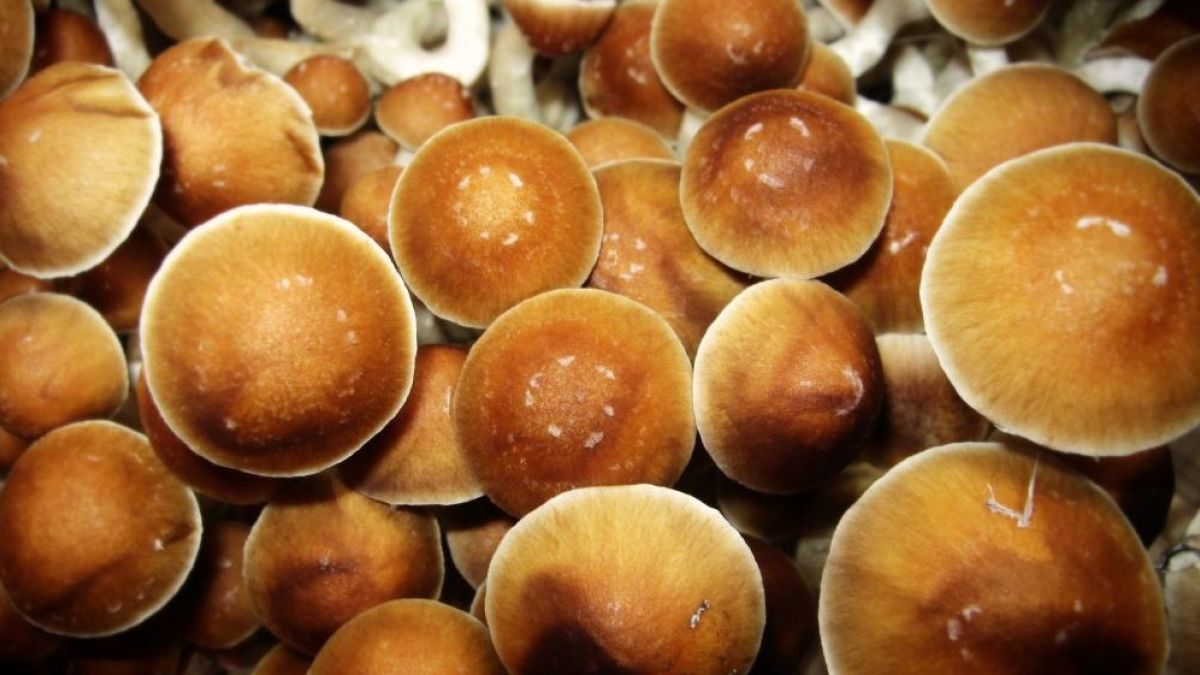
The fruiting body presents a very distinct, elegant design. For example, the mature caps display a soft, golden-tan hue with a slightly darker, reddish-brown center. This recognizable coloration has earned the variant its reputation as one of the most iconic yellow-capped fungi in modern mycology. Furthermore, the flush expands into a wide, planar umbrella shape at full maturity, measuring anywhere from two to five centimeters in diameter.
The Stalk and Veil Mechanics
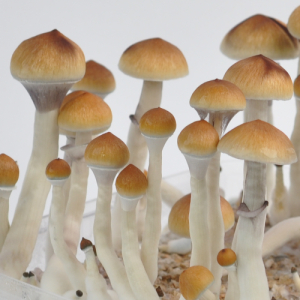
Below the pileus, the organism develops a hollow, fibrous stalk. This stem features a slightly thicker base that tapers gently toward the gill attachment area. Additionally, a delicate partial veil protects the immature gills during the early fruiting stages. As the cap expands, this membrane tears away cleanly. Subsequently, it leaves behind a dark, persistent annulus ring on the upper portion of the stem.
Laboratory Observation of a Standard Microscopy Research Specimen
Maintaining optimal environmental controls prevents sample degradation during long-term study. Thus, technicians follow strict sterile techniques when handling delicate cultures.
Mycelial Density and Colonization Rates
-
Rhizomorphic Growth Patterns: The strain develops a highly aggressive, rope-like robust rhizomorphic mycelium on agar media. Consequently, it navigates nutrient sources with high efficiency.
-
Spore Print Identification: A mature classic archival spore isolation produces dense, dark purple-brown spore prints. In fact, these prints feature a smooth, thick-walled ellipsoid structure under microscopic analysis.
-
Contamination Resistance: Due to decades of selective stabilization, the living tissue exhibits strong resilience against common airborne molds. As a result, it serves as an ideal standard microscopy research specimen for introductory training.
Documenting Fungal Lineages Domestically
Global collection centers continuously trade verified spore samples to preserve ancestral genetics. Similarly, international herbaria catalog these movements to ensure that laboratory samples remain true to their historic baselines. Ultimately, studying the lineage of Golden Teachers provides an objective look at how deliberate domestic selection shapes the physical evolution of fungi over time. Domesticated Psilocybe cubensis strain
Additional information
| weight | Oz, 1/4 lb, Hp, Lb |
|---|
Related products
-
- Sale!
DMT Vape Cartridges
- Original price was: $350.00.$250.00Current price is: $250.00.
- Add to cart
-
- Sale!
Buy Ketamine nasal spray
- Price range: $270.00 through $13,500.00
- Select options This product has multiple variants. The options may be chosen on the product page
-
- Sale!
BUY AMAZON CUBENSIS ONLINE
- Original price was: $100.00.$65.00Current price is: $65.00.
- Add to cart

Reviews
There are no reviews yet.